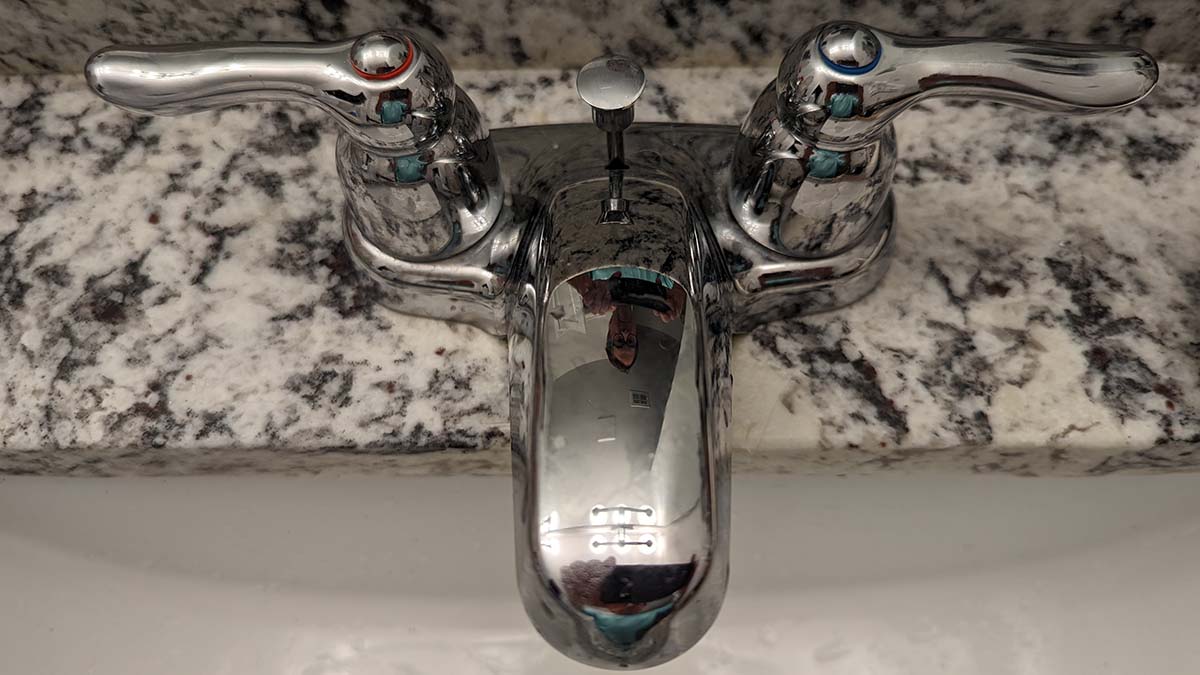
(UPDATE: this article was published in 2022 but now in 2025 Georgia lawmakers have officially re-formed the “Lake Lanier Caucus” to investigate the ongoing issues with our drinking water quality (specifically the weird smells, tastes, and “cloudy” water many have reported.) This investigation is directly related to the “black dirt” some of us have found in our faucets and aerators described below.
Did you know a bacteria in Lake Lanier can cause your water faucet filters to grow black slime dirt that falls into your sink? Here’s how to fix it!
One year after moving into my brand new home in 2021, I was brushing my teeth when I noticed a curious anomaly: black specks falling from my bath faucet into the sink. Wondering what was going on, I rubbed my finger on the underside of the faucet screen, and it came away coated in a black, sponge-like material. When I turned on the water and rubbed the screen again, even more of the dark substance washed out.
What a mystery! My home was new, built in 2021, and the water tested clean. Was it a defect in the faucet? Was my water heater disintegrating?
The Investigation – First, I tried to unscrew the screen to clean it. My fingers couldn’t budge it, and standard pliers were useless (and risky, as they can damage the finish). I used my phone to take a photo of the underside and discovered a unique plastic screen recessed inside the spout with tiny notches around the rim. And you can see the black gunk on the faucet screen in this photo, except for the silver area where I had rubbed it off with my finger!
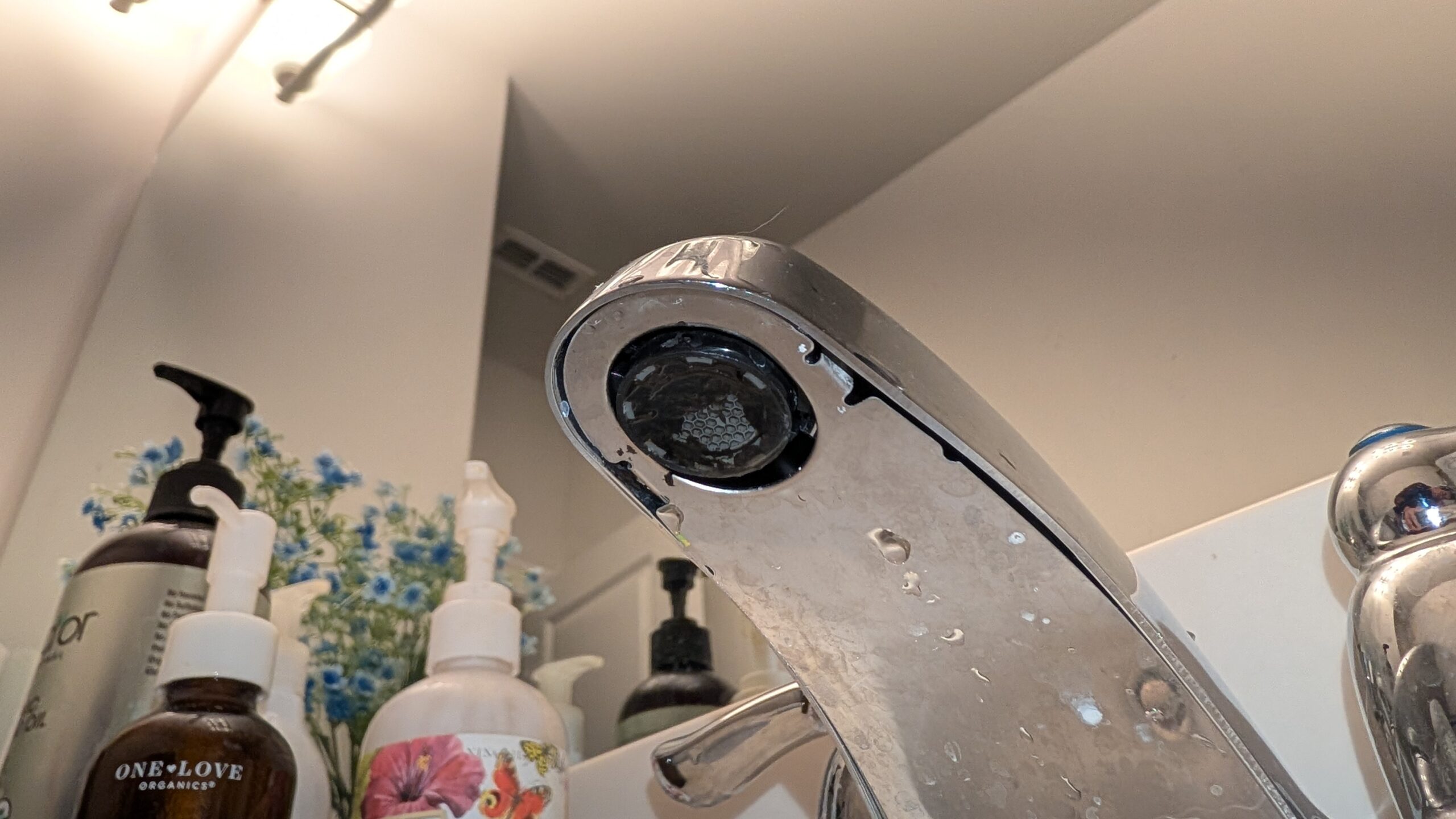
Digging through my builder’s documents, I confirmed I had Moen Chateau #4925 faucets. These don’t use standard screw-on caps; they use “Cache” aerators that require a special plastic key to remove. Since the builder hadn’t left the tool behind, I initially ordered replacement kits (Part #180158) directly from Moen.
When the new parts arrived, I used the included key to remove the old aerators. They were gunked up with a slimy black substance—not just on the screen, but growing into the grooves. I replaced them with new Moen aerators, thinking the problem was solved.
The “Ghost” Returns – Here is where the mystery deepened. Despite brand new Moen aerators, the black slime soon returned time and again!
It turns out, this wasn’t dirt, and it wasn’t a defect. It was science.
The Real Culprit: Manganese Bacteria – Using Google’s Gemini AI, I showed it a photo of the black slime on the aerator, and Gemini immediately revealed this black slime is a biofilm created by Manganese-oxidizing bacteria. This bacteria is harmless to humans and naturally present in our Lake Lanier water source. It feeds on trace amounts of manganese minerals in the water. When I asked AI if I should call the water company, Gemini said no, they’ll say the bacteria is safe, or the problem was the design of the aerators!
The standard Moen aerators were acting as perfect incubators. Their fine mesh screens mixed air with the water (oxygen) and trapped the minerals, creating an ideal environment for this bacteria to thrive. That’s why the slime was growing on the underside where the air hits the water, not coming from the pipes inside.
The Permanent Fix: Go “Laminar” – Cleaning isn’t enough because the bacteria leaves behind a microscopic film that acts like roots, causing it to regrow quickly. And replacing it with the same Moen part just resets the clock.
The permanent solution is to starve the bacteria of the environment they need. I switched to a Laminar Flow Aerator. I can now brush my teeth with peace of mind—and a crystal-clear stream of water—knowing the black mystery is gone for good!
- What laminar means: Unlike a standard aerator that mixes air into the stream (making it white and bubbly), a laminar device produces a crystal-clear, solid stream of water (like a glass rod). Laminar aerators are required in hospitals and medical offices specifically to avoid bacteria!
- Why it works: It has no fine mesh screens to trap particles and introduces no air into the stream. Without the oxygen-rich mesh “condo,” the bacteria cannot establish a colony.
How to Fix Yours – If you have the mysterious black slime, you need to replace the aerators in your faucets with laminar aerators. You’ll need whatever size your faucet requires, but here’s how I found mine:
- Identify your size: For Moen Chateau faucets, the size is usually “Tiny Junior” (M18.5)—about the size of a dime.
- Buy the right part: Look for a “Neoperl Cache Laminar Aerator” (specifically 1.2 GPM Tiny Junior M18.5×1). This happens to be the firm that Home Depot stocks for replacing aerators on many faucet brands.
- Install: You’ll need to use the special plastic key (usually included and shown in the photo below) to remove and install aerators. Pliers etc. won’t work.
Where to buy? I found Home Depot and Lowes and Ace didn’t have laminar aerators in the store, so I ended up having Home Depot ship for free the correct part in the mail. Two aerators with the necessary key you need to install them cost about $8. Click this to view.
WARNING! If it doesn’t say Laminar specifically in the product title or specifications it will not solve the problem. There are many aerators that sound correct but they are not laminar. And be sure to get the exact size your faucets require.
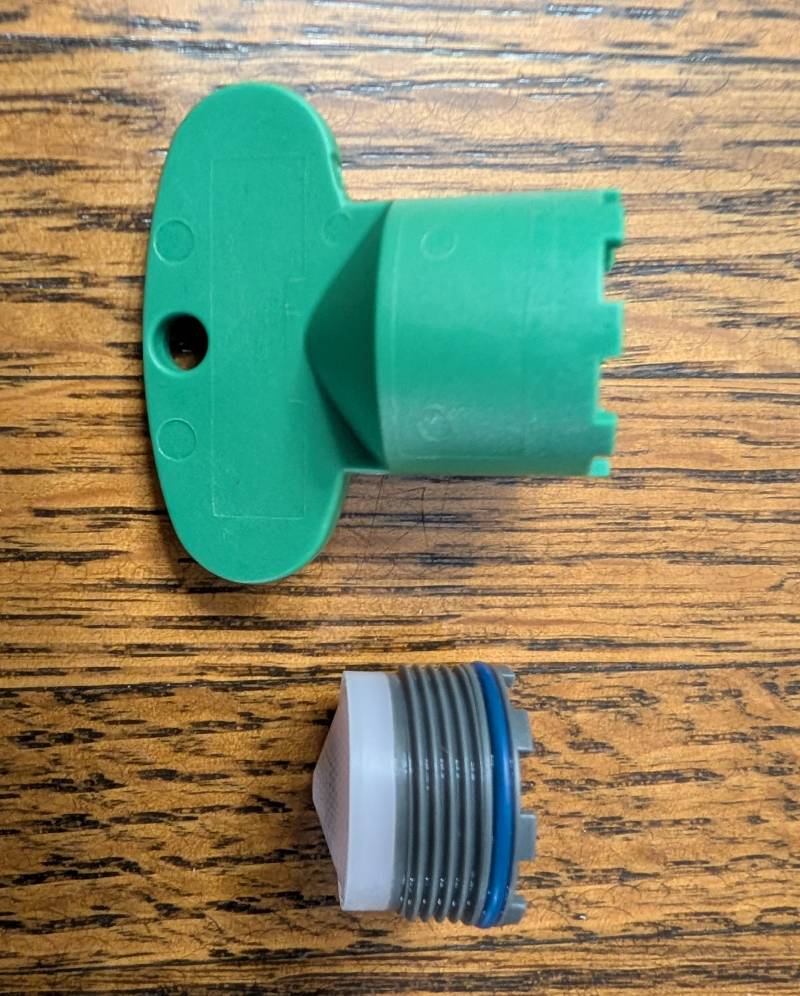
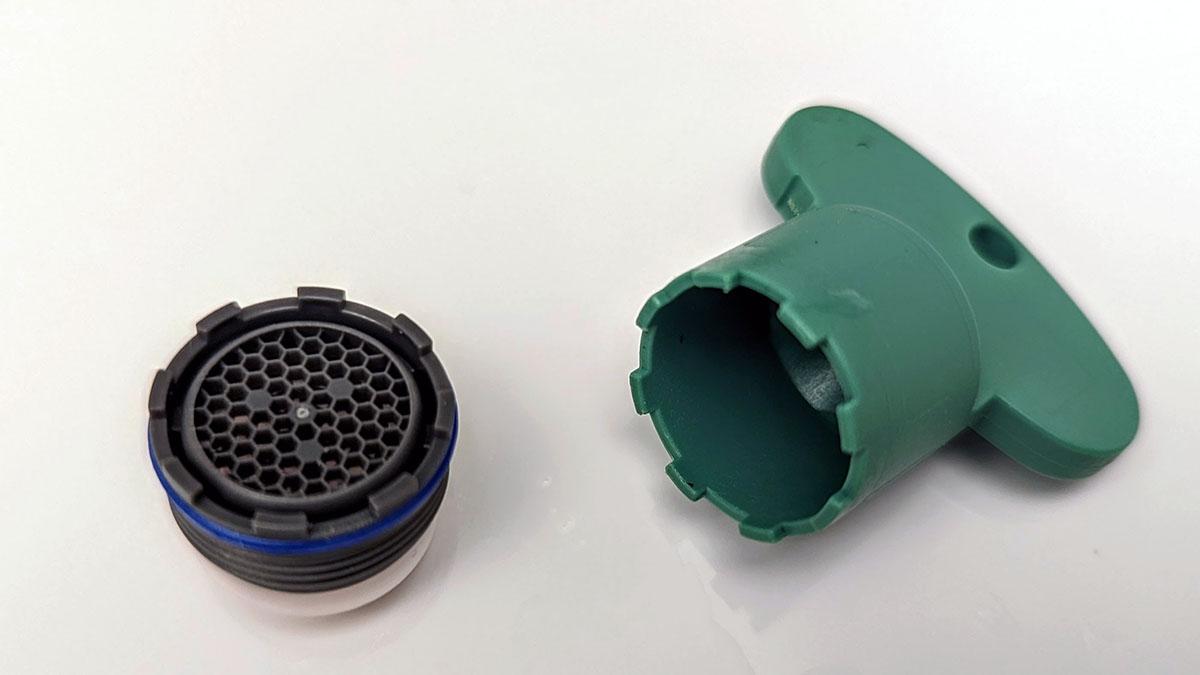
Using the tool, I removed the aerator while looking down above the faucet, turning clockwise (which is counter-clockwise if I was under the faucet looking up). Sure enough, when the aerator was out, I saw it was gunked with slimy black dirt in the screen and circular groves around the rim. I could see dirt inside the aerator, too. With no aerator on the sink now, I ran water until it ran clean, then installed the new aerator. Hard to think a 1-year old aerator could be so dirty when all I do at this sink is brush my teeth and wash my hands.
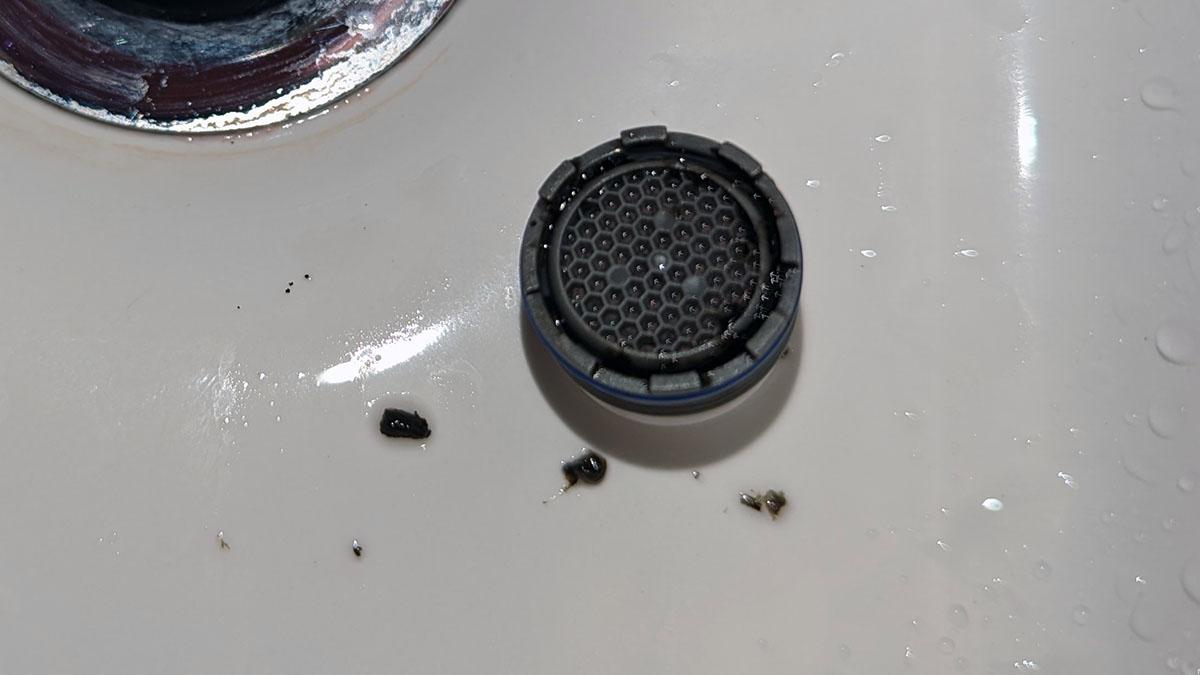
Now, perhaps without removing the old aerator I could’ve cleaned the outside somewhat with an old toothbrush, rather than replace it. But inside the aerator I saw dirt, and I read aerators have to be replaced over time anyway. With my new one installed, it was immediately evident I had stronger water flow than before, so spending $11 was worthwhile. I certainly feel better when brushing without worrying about black dirt on my toothpaste!
I have the same issue. I have cleaned the screens 3 times in 2 1/2 years. I sure would like to know what that black goop is.